China Top 10 EEG Machine Manufacturers for Global Buyers
China’s EEG industry includes manufacturers serving hospitals, neurology clinics, research teams, and distributors. For global buyers, choosing an Eeg Machine involves more than comparing prices or channel counts. The right system must fit its intended clinical or research use. Consider electrode types, signal quality, software workflow, portability, and compatibility with existing equipment. Details matter.
This guide introduces ten Chinese manufacturers and offers a practical starting point for supplier evaluation. Product specifications can look similar on paper, yet daily use may feel different. Ask for clear documentation, demonstrations, user training, warranty terms, and responsive technical support. Check whether the relevant product has the registrations or certifications required in your destination market; requirements vary, and should be confirmed with qualified local sources. Also assess the manufacturer’s export experience and ability to provide service after delivery.
A shortlist is not a substitute for due diligence. Request current specifications and verify claims directly with each supplier. Where possible, involve clinicians or biomedical engineers who will use or maintain the system. A brief trial can reveal issues that brochures miss, such as setup time, electrode handling, or software usability. No single manufacturer suits every buyer. This comparison aims to clarify the questions worth asking, while recognizing that product quality and support can change over time. A careful evaluation takes effort. And some uncertainty remains.
EEG Fundamentals: 0.5–30 Hz Bands and the International 10–20 System
For global buyers comparing EEG equipment, understanding the signal matters as much as comparing specifications. Routine scalp EEG often examines activity from about 0.5 to 30 Hz. Delta is commonly described as 0.5–4 Hz, theta as 4–8 Hz, alpha as 8–13 Hz, and beta as 13–30 Hz. These ranges are useful guides, not rigid borders. Small shifts matter. Eye movements, muscle tension, and poor electrode contact can also alter the trace, so frequency alone does not explain what a waveform means.
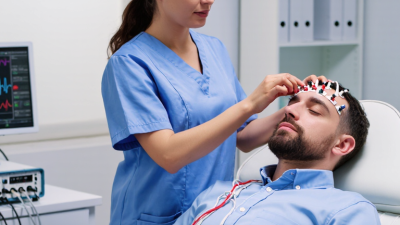
The International 10–20 System helps place electrodes consistently across different head sizes. Measurements use percentages of the distance between landmarks, such as the nasion and inion, rather than fixed centimetres. Odd numbers generally mark the left side, even numbers the right, and “z” identifies the midline. This gives clinicians and technicians a shared map for recording and reviewing signals. In practice, the neat textbook picture can be messier: hair, movement, and individual anatomy may complicate placement.
Tips: Check that the device supports the montage and sampling settings your workflow requires. Confirm electrode labels against the placement map before recording. Keep the scalp prepared and inspect contact quality; a loose lead can look like a meaningful signal. Document deviations, even minor ones. Consistent setup improves comparisons, but it cannot remove every source of uncertainty.
China Top 10 EEG Machine Manufacturers for Global Buyers - EEG Fundamentals: 0.5–30 Hz Bands and the International 10–20 System
| No. |
Reference Item |
Factual Detail |
Relevance for Global Buyers |
| 1 |
Conventional EEG band |
The 0.5–30 Hz range is commonly used as a conventional EEG review band; actual acquisition and display filters depend on the system and application. |
Check configurable high-pass and low-pass filters, and confirm that the selected settings suit the intended clinical or research use. |
| 2 |
Delta activity |
Approximately 0.5–4 Hz. |
Low-frequency response and artifact handling matter when reviewing slow activity; filter choices can affect what is displayed. |
| 3 |
Theta activity |
Approximately 4–8 Hz. |
Verify that recordings can be reviewed across the intended frequency range without inappropriate filtering. |
| 4 |
Alpha activity |
Approximately 8–13 Hz. |
The displayed frequency content depends on recording settings; ensure those settings can be reviewed and documented. |
| 5 |
Beta activity |
Approximately 13–30 Hz. |
Check the configured upper frequency limit and sampling settings for the intended recording protocol. |
| 6 |
10–20 placement intervals |
Electrode positions are determined using 10% or 20% divisions of measured head distances, including the nasion–inion and preauricular measurements. |
Confirm that electrode caps, placement guides, and setup documentation support the required montage and measurement method. |
| 7 |
Electrode letter codes |
Common codes include Fp (frontopolar), F (frontal), C (central), P (parietal), O (occipital), and T (temporal). |
Review channel labels and montage configuration to ensure they correspond to the intended electrode locations. |
| 8 |
Left and right numbering |
Odd numbers identify left-hemisphere positions; even numbers identify right-hemisphere positions. |
Consistent labels help users check channel locations and interpret recordings across standard montages. |
| 9 |
Midline designation |
The letter “z” denotes a midline position, as in Fz, Cz, and Pz. |
Check that the recording software correctly displays midline channels in electrode lists and montage views. |
| 10 |
Sampling and bandwidth |
To represent frequencies up to 30 Hz, the sampling rate must exceed 60 samples per second under the Nyquist criterion; practical systems use application-specific rates and anti-alias filtering. |
Compare sampling-rate options, anti-alias filtering, data export, and protocol requirements rather than relying on a single rate for every use case. |
Note: EEG band boundaries are conventional and may vary slightly by reference or application. This table summarizes technical fundamentals and buyer-check points; it does not rank or identify manufacturers.
China’s EEG Supplier Landscape: 10 Manufacturers for Clinical and Research Use
China’s EEG supplier landscape is broad, but a ten-manufacturer shortlist should start with intended use, not catalogue size. Clinical monitoring needs dependable electrode contact, clear impedance checks, and stable acquisition during long recordings. Research teams may instead prioritize flexible channel counts, event marking, and data export. Small details matter: a loose electrode can turn a quiet recording into hours of artifact review.
The World Health Organization’s 2024 epilepsy fact sheet estimates that about 50 million people live with epilepsy worldwide; nearly 80% are in low- and middle-income countries. This underlines the need for accessible diagnostic capacity, though it does not measure EEG equipment demand directly. When comparing Chinese manufacturers, buyers should check sample recordings, stated sampling rates, electrical safety documentation, software workflows, and local service response. Ask for evidence, not promises.
For a ten-supplier evaluation, request the same test protocol from each: record a short simulated session, inspect signal quality, then verify file export and electrode compatibility. Clinical and research requirements can overlap, but they are not interchangeable. A low purchase price may still bring costly training or maintenance gaps. I would also treat published specifications cautiously until they are confirmed on the actual system. One honest limitation: public, independent comparisons of Chinese EEG manufacturers remain scarce.
Device Specifications: Channel Count, Sampling Rate, and IEC 60601-2-26
For global buyers, channel count should match the intended examination, not just the product headline. The classic international 10–20 system uses 21 scalp electrode positions, as described in clinical EEG standards. More channels can support denser recordings, but they also mean more electrodes to place and more data to review. In practice, check whether the stated count includes reference, ground, and auxiliary inputs. Small numbers matter. The American Clinical Neurophysiology Society’s Guideline 1 (2016) recommends a sampling rate of at least 256 samples per second per channel for clinical EEG. Higher rates may help preserve fast signal detail, but they increase storage needs and do not compensate for poor electrode contact.
IEC 60601-2-26 specifies safety and essential-performance requirements for electroencephalographs. Buyers should request test documentation and confirm that the declared configuration matches the offered device, including its channels and accessories. Compliance is not a shortcut for evaluating signal quality. Ask how the system handles impedance checks, artifact display, and data export; then review sample recordings under realistic conditions. I would still question any specification sheet that lists a high sampling rate without stating the recording bandwidth or usable channel count. That omission makes comparisons harder. The IEC standard and ACNS guidance provide useful checkpoints, but local clinical workflows and qualified-user review remain important.
Comparing Manufacturers: ISO 13485, Clinical Evidence, and Data Connectivity
Global buyers should compare more than channel count and screen size. The WHO reports that about 50 million people live with epilepsy, with nearly 80% in low- and middle-income countries. This makes dependable service, training, and accessible data export practical purchasing concerns. A current ISO 13485 certificate indicates a quality-management system for medical devices; it does not prove diagnostic accuracy.
Clinical evidence deserves close review. Check whether published studies tested the same electrode setup, sampling rate, and patient group as the offered system. The 2015 AAN/AES guideline on a first unprovoked seizure reported a 2.16 relative rate of recurrence when epileptiform EEG abnormalities were present. That finding supports the clinical value of EEG, but it does not validate any particular machine. Ask for study protocols, sample sizes, and limitations—not just a list of citations.
Tips: Request a sample EDF+ recording and test whether annotations, timestamps, and patient identifiers survive export. Confirm API or hospital-system integration, plus documented data-protection controls. A smooth live demo is useful, but a real workflow test may reveal awkward steps. Be willing to revisit your scorecard after testing.
China Top 10 EEG Machine Manufacturers for Global Buyers
When comparing suppliers, verify the scope and validity of each ISO 13485 certificate, review clinical evidence for the specific device model, and confirm data-export formats and interoperability. The chart below provides EEG signal-frequency context; it does not rank manufacturers.
Conventional EEG bands are commonly described as delta (0.5–4 Hz), theta (4–8 Hz), alpha (8–13 Hz), and beta (13–30 Hz). Band boundaries can vary by convention and application. Certification, clinical evidence, and connectivity should be assessed against the exact manufacturer, device model, and intended market.
Global Buyer Checks: 50/60 Hz Interference Control, Registration, and Support
For global buyers comparing China’s top EEG machine manufacturers, 50/60 Hz interference control deserves a hands-on check. Ask for a demonstration using the intended electrode set, cables, and recording environment. Look for stable traces near power equipment, clear filter settings, and documented performance against the applicable edition of IEC 60601-2-26. A clean screen in a showroom is not enough. WHO estimates that about 50 million people worldwide live with epilepsy, making dependable recordings important in clinical assessment (WHO, “Epilepsy” fact sheet, 2024). Still, no single interference test represents every hospital room.
Registration checks need equal care. Request the exact model’s registration documents for each target market, and verify that the model name, intended use, and manufacturer details match. Ask for current test reports and a written list of included accessories. Support should be concrete: response hours, software updates, electrode and cable availability, training language, and repair turnaround. If the supplier gives only a broad warranty statement, ask what happens when a recording channel fails midweek. Small details matter.
Tips: Before purchase, record a short test with the unit connected to your own electrodes and computer setup. Compare traces with filters adjusted and unchanged. Ask support to explain a sample artifact, not just show a polished waveform. Keep the evaluation notes; they may expose gaps you did not expect.