What Is Shilajit Extract Used For?
Shilajit Extract is commonly marketed for energy, stamina, and general wellness. It comes from a mineral-rich substance found in mountainous regions and is sold as capsules, powders, and purified resin. The label may look simple. The contents can vary.
Some claims have limited human research behind them. A randomized, double-blind clinical study published in Andrologia in 2016 examined purified shilajit in healthy men aged 45–55. Participants took 250 milligrams twice daily for 90 days. Researchers reported increases in testosterone-related measures, including total testosterone and DHEAS. That is a specific finding, not proof that Shilajit Extract improves energy, fertility, or performance for everyone. The study was also limited in scope, so broader conclusions need more research.
What should readers look for? A clear ingredient list, a stated amount per serving, and independent testing for identity and contaminants. Shilajit products are not interchangeable. Processing matters. So does quality control. Dietary supplements can also interact with medicines or be unsuitable for some people, including those with certain health conditions. A clinician or pharmacist can help assess individual risks.
This guide looks at what Shilajit Extract is used for, what research actually supports, and where evidence remains uncertain. Traditional use can offer context. It cannot replace well-designed clinical trials. That distinction matters.
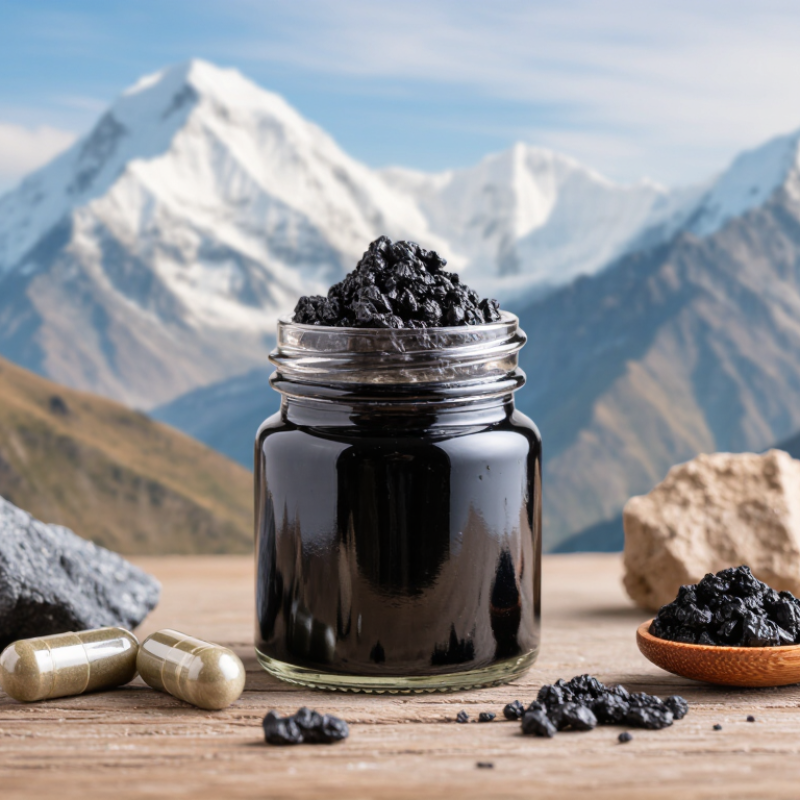
What Shilajit Extract Is and How It Is Produced
Shilajit is a dark, resin-like material that seeps from cracks in high-altitude rocks. It forms over long periods from decomposed plant matter and other organic material. It is not one pure compound. A review by Carrasco-Gallardo and colleagues in the International Journal of Alzheimer’s Disease (2012) describes it as a complex mixture whose composition varies by source. Agarwal and colleagues’ 2007 review in Phytotherapy Research identifies fulvic acids, dibenzo-α-pyrones, and minerals among its reported constituents. Published analyses report varied mineral profiles, not one fixed recipe.
Production typically begins by collecting raw material and separating visible rock and debris. The material is then commonly dissolved in water, filtered, and concentrated; some processes use further purification and drying. The details differ. A clear amber-brown liquid may be concentrated into a thick resin or dried into powder. Heat and filtration can affect the final material, so “purified” does not automatically mean identical.
That variability matters. A 2012 review notes differences linked to geographic origin and processing, making batch testing important. Testing can check identity, mineral content, and contaminants such as heavy metals. Buyers rarely see the full processing record. That gap deserves attention. A careful description should explain the source, purification steps, and test methods, rather than treating every dark resin as equivalent.
Traditional Uses of Shilajit Extract
What Is Shilajit Extract Used For?
Traditional Uses of Shilajit Extract
In Ayurvedic tradition, shilajit has been used as a rasayana, a substance associated with vitality and healthy aging. Traditional uses include supporting stamina, recovery, and general wellbeing. It is a dark, resin-like material collected from rocky mountain regions. Its appearance can resemble thick tar, but its composition varies by source and processing. Traditional use is not proof of a treatment effect.
Modern research remains limited. A 2016 randomized, placebo-controlled study in Andrologia followed healthy men aged 45–55 who took purified shilajit or placebo for 90 days. Researchers reported increases in testosterone-related measures in the shilajit group. The study was small and does not establish benefits for everyone, or confirm traditional claims about energy and aging. More independent research is needed.
Tips: Choose products with independent testing for identity, heavy metals, and microbial contamination. Check the label for purified extract and serving size. Ask a qualified health professional before use, especially if you take medication or have a health condition. Quality matters. Some traditional preparations may differ substantially.
What Is Shilajit Extract Used For? — Traditional Uses
Traditional Ayurvedic descriptions associate shilajit with these broad use themes.
Each bar indicates that the use theme is traditionally described (1), not how often it is used or how effective it is. Traditional use does not establish clinical benefit or safety.
Potential Uses Examined in Modern Research
What Is Shilajit Extract Used For?
Modern research has examined shilajit for hormone levels, energy metabolism, and cognitive health. Evidence remains limited. In a randomized, placebo-controlled study published in Andrologia in 2016, 75 healthy men aged 45–55 took purified shilajit, 250 mg twice daily, or a placebo for 90 days. Researchers reported increases in total testosterone, free testosterone, and DHEAS in the shilajit group. These are measured hormone changes, not proof of improved fertility, strength, or everyday wellbeing. The study was also small and short. That matters.
Researchers have also explored shilajit’s antioxidant compounds and possible effects on cellular energy, but much of this work comes from laboratory or animal studies. Human evidence for clearer thinking, reduced fatigue, or better exercise performance is not yet strong enough to support firm claims. Composition can vary between preparations, too. Purity matters. Shilajit may contain unwanted contaminants if poorly processed, and supplements can interact with health conditions or medicines. People considering it should discuss use with a qualified healthcare professional, especially if pregnant, managing a condition, or taking medication. A promising result is not the same as a proven treatment.
Common Forms and Ways to Take Shilajit Extract
Shilajit extract is commonly sold as resin, powder, capsules, or liquid. Resin is sticky and dark, and usually needs stirring into warm water or milk. Powder can be measured into a drink, while capsules offer a premeasured option. Products differ in concentration and processing, so the form alone does not show how much active material a serving contains.
Research offers a reference point, not a universal serving rule. A 2016 clinical study in Andrologia examined purified shilajit at 250 mg twice daily for 90 days in 75 men. That trial used a specific preparation and cannot establish equivalent doses for every resin, powder, or capsule. Check the product label, and ask a healthcare professional before use, especially if you take medication or have a health condition. Evidence remains limited.
Tips: Choose products with independent testing for identity and contaminants, and follow their serving directions. Keep the original container. If the taste is strong, mix a small serving into a warm drink rather than guessing at a larger amount.
Safety, Side Effects, and Quality Considerations
What Is Shilajit Extract Used For?
Safety deserves more attention than bold promises on a supplement label. Shilajit products can vary in composition, and contamination with heavy metals or microbes is a concern. Purification alone is not proof of safety. A polished label is not proof either.
Look for independent, batch-specific testing that identifies the material and checks lead, arsenic, mercury, cadmium, and microbial contamination. A certificate should match the exact product batch, not just describe general testing practices. If the seller cannot provide clear results, that uncertainty matters. It is easy to overlook.
Some people may experience stomach upset or an allergic reaction. Research on interactions and long-term use remains limited, so people taking medication or managing a health condition should ask a qualified health professional before use. Extra caution is sensible during pregnancy or breastfeeding, when safety information is inadequate. People with iron-overload conditions should also seek medical advice, since mineral content may vary. Supplements can differ from one batch to another. That is worth remembering.


